

Student housing across Huddersfield often operates under different pressures compared to standard rental properties. High tenant turnover, shared living arrangements, and varying levels of property management can all influence how safe a property actually is over time.
Unsafe living conditions do not automatically lead to legal responsibility. A claim may be possible where an identifiable risk was not addressed and that failure contributed to an injury.
Understanding how these situations develop is key to understanding where liability may sit.
How problems typically develop in student housing
Issues in student accommodation usually develop over time. They tend to build over time.
A property may already have underlying problems at the point of move-in. These might not seem serious at first, but without intervention, they can become more significant.
Students may:
- tolerate issues longer than other tenants
- assume problems are part of shared living
- delay reporting or follow-up
At the same time, landlords or managing agents may not become aware of the severity of a problem until it has progressed.
The result is a gradual shift from inconvenience to potential risk.
How a typical situation unfolds
Stage 1 – move-in condition
A group of tenants moves into a shared house. There are minor issues present, such as damp patches or loose fittings, but nothing that immediately prevents use of the property.
Stage 2 – early warning signs
Over time, the damp spreads or fixtures become less stable. Electrical outlets may begin to show signs of wear due to heavy use.
Stage 3 – reporting or lack of action
The issue is either reported or left unreported. If reported, the response from the landlord or agent becomes important. Delays or incomplete repairs can allow the problem to persist.
Stage 4 – escalation
The condition worsens. Damp may affect air quality, or a loose step may become unstable. What was previously manageable starts to present a clearer risk.
Stage 5 – incident
An injury occurs. This could involve a fall, exposure-related illness, or another hazard linked to the original issue.
This sequence highlights that responsibility is often tied to how the situation was handled over time rather than the final event alone.
Why student housing creates unique risk conditions
Student properties often involve multiple occupants using shared facilities. This increases wear and reduces clarity around responsibility for day-to-day conditions, which can lead to disputes among tenants regarding maintenance and cleanliness responsibilities.
Other contributing factors can include:
- varying standards between different landlords
- limited oversight in privately managed properties
- high demand leading to faster occupancy cycles
These factors do not create liability on their own, but they can increase the likelihood that issues develop without being addressed promptly, leading to potential safety hazards and tenant dissatisfaction if not managed effectively.
How responsibility is typically shared
Responsibility in student housing is rarely isolated to one party.
Landlords are generally responsible for maintaining the structure and safety of the property. This encompasses addressing hazards once they become known or reasonably identifiable.
Letting agents, where involved, may take on management duties such as coordinating repairs or inspections.
Tenants are usually expected to use the property reasonably and report issues when they arise. However, they are not typically responsible for structural safety or long-term maintenance.
The interaction between these roles often determines how liability is assessed.
Common hazards in student housing
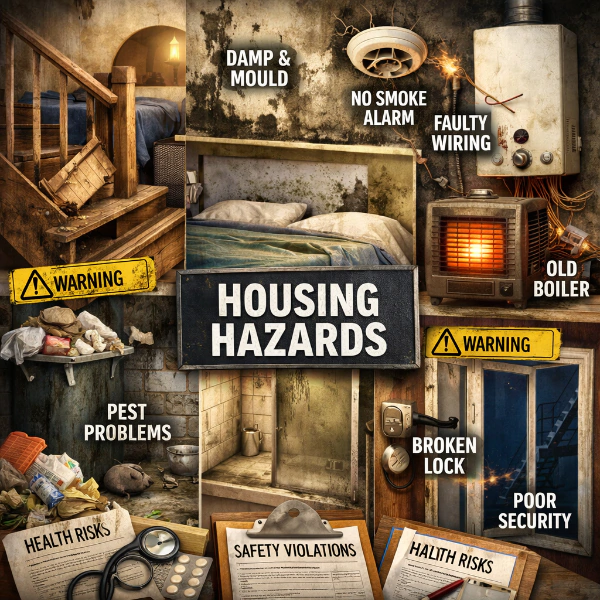
- damp and mould affecting living conditions
- faulty or overloaded electrical systems
- loose flooring, stairs, or fixtures
- inadequate fire safety measures
- broken locks or insecure entry points
- poor ventilation in shared spaces
- unsafe kitchen layouts or equipment
- delayed repairs despite reported issues
These hazards vary in severity, but each has the potential to contribute to injury if not addressed.
What changes liability in these situations
The presence of a hazard is only part of the picture.
What matters is how that hazard was managed.
Key considerations often include:
- whether the issue was reported
- how quickly action was taken
- whether the risk was obvious or developing over time
A landlord who responds promptly and effectively may be viewed differently from one who allows a known issue to continue, especially if the issue poses an immediate risk to tenants’ safety or well-being.
When a claim may be possible
For a claim to be considered, three elements generally need to align:
- a duty of care existed
- that duty may have been breached
- the breach contributed to the injury
In student housing, the outcome often depends on the history of the issue rather than the incident alone.
For example, a loose stair may not create liability if it appeared suddenly and was unknown. The position may be different if it had been reported multiple times without repair.
Where does legal support fit in?
Determining whether a situation meets the threshold for a claim can require a detailed review of what happened over time.
Firms such as Marley Solicitors may assist by examining how responsibility was shared between landlord, agent, and tenant, and whether the response to known risks was adequate.
This type of assessment is particularly important where multiple parties are involved.
What evidence tends to matter?
In cases involving ongoing conditions, the timeline is often more important than a single moment.
Relevant evidence may include:
- records of maintenance requests or complaints
- communication between tenants and landlords or agents
- tenancy agreements outlining responsibilities
- photographs showing how the condition developed over time
This helps establish whether the risk was identifiable and how it was handled.
Why these cases are often unclear
Student housing cases can be difficult to assess because responsibility is shared and conditions evolve.
Challenges can include:
- multiple occupants affecting how issues are reported
- delays between problem identification and action
- difficulty linking the condition directly to the injury
These factors mean that each case needs to be considered on its own facts rather than assumed based on the presence of a hazard.
Final point: It is the response to risk that matters
Unsafe conditions in student housing do not automatically lead to legal responsibility.
What matters is whether the risk was identified and whether reasonable steps were taken to address it.
If a problem develops and is managed appropriately, liability may be limited. If it is ignored or left unresolved, the position may be different.
Understanding that progression is what determines whether an issue becomes a legal matter rather than simply a housing concern.