

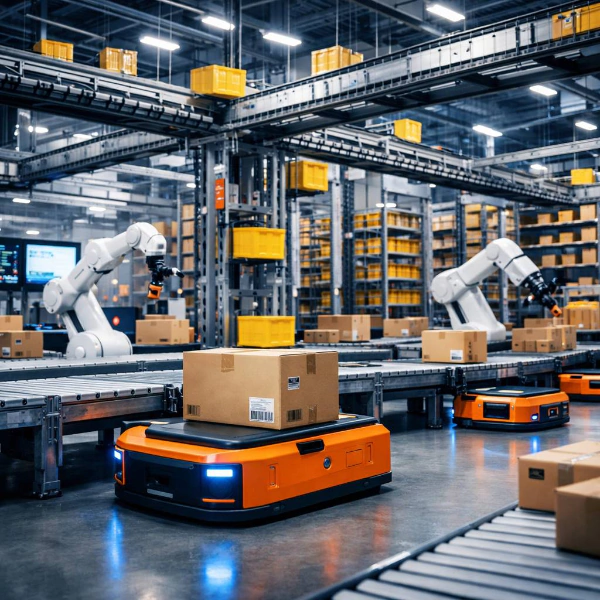
Automation has changed how warehouses operate across Barnsley. Faster pickup systems, autonomous vehicles, and robotic arms are now standard in many distribution centres.
That shift has also changed how workplace accidents happen.
When an injury involves machinery that “acts” on its own, responsibility is not always obvious. The question is no longer just what a worker did wrong or whether an employer failed to supervise. It becomes a layered issue involving systems, maintenance, and decision-making around risk, particularly in how these factors interact to influence the safety and reliability of automated machinery in the workplace.
This guide explains how liability is assessed when warehouse automation fails and what actually determines whether a claim may be possible.
A realistic scenario: when automation fails in practice
A worker in a Barnsley fulfilment warehouse is assigned to a picking zone shared with automated guided vehicles (AGVs). These machines move stock between stations without direct human control.
During a routine shift, one unit fails to detect a stationary worker due to a sensor fault. It continues moving and collides with the worker, causing a serious leg injury.
Initial assumptions might suggest:
- the worker was in the wrong position
- the system malfunctioned unexpectedly
- no one could have prevented it
In reality, the outcome depends on deeper questions:
- Was the system properly maintained?
- Were safety zones clearly enforced?
- Had similar faults been logged before?
The answers to those questions shape where responsibility may sit.
Where responsibility actually sits in automated warehouses
Automation does not remove employer responsibility. It often expands it.
In most cases, liability is assessed across three potential areas:
Employer responsibility
Employers are generally expected to:
- provide a safe working environment
- ensure systems are fit for use
- train staff to work safely around automation
If risk assessments are incomplete or ignored, responsibility may still sit with the employer even when machines are involved.
System manufacturer or supplier
If the accident stems from a design or manufacturing defect, responsibility may extend beyond the workplace.
Such liability is not automatic. It depends on whether:
- the system was inherently unsafe
- faults existed from installation
- warnings or limitations were not properly disclosed
Maintenance and servicing providers
Many automated systems rely on third-party servicing.
If a known issue was missed, poorly repaired, or left unresolved, liability may shift toward whoever was responsible for maintaining the system.
Why automation accidents are harder to prove
Compared to traditional workplace incidents, automation introduces a key complication: data dependency.
Often, what happened is not immediately visible. It must be reconstructed through system records.
That creates challenges such as:
- reliance on internal logs controlled by the employer
- gaps in recorded data
- difficulty interpreting technical faults
It also means that two incidents that look identical on the surface can have entirely different legal outcomes depending on the underlying evidence.
What evidence changes the outcome?
In automation-related injuries, evidence usually includes more than witness statements.
The most influential factors often include:
- system event logs showing machine behaviour at the time of the incident
- maintenance and servicing records
- prior fault reports or warning notices
- training records for staff working in the area
- internal risk assessments and safety protocols
If these show that a risk was known but not addressed, the likelihood of employer responsibility increases. If they show an unexpected system failure despite proper procedures, responsibility may be less clear.
Key liability triggers in automation accidents
While every case depends on its facts, certain patterns tend to influence how responsibility is assessed:
- failure to maintain or service automated equipment
- inadequate separation between workers and machines
- lack of clear safety procedures or enforcement
- known faults being ignored or delayed
- insufficient staff training for automated environments
These do not guarantee a successful claim. They indicate where a breach of duty may exist, which is central to any legal assessment.
How claims are assessed in practice
For a workplace injury claim to succeed, it generally needs to show:
- a duty of care existed
- that duty may have been breached
- the breach caused the injury
In automated environments, the second point is often the most contested.
Employers may argue:
- the system met industry standards
- the incident was unforeseeable
- procedures were in place but not followed
Each argument must be tested against the evidence.
This is why automation cases are often more complex than standard workplace accidents. The outcome depends less on the visible incident and more on what sits behind it.
Why these cases are becoming more common
As warehouses continue to adopt automation, the risk profile changes rather than disappears.
Common trends include:
- increased interaction between humans and machines
- reliance on software-driven decision making
- reduced visibility of system faults until failure occurs
This situation creates a gap between perceived safety and actual risk.
Workers may assume systems are fail-safe. In reality, they are only as reliable as the processes supporting them.
Where specialist legal support fits in
Automation-related injury claims often involve technical evidence that goes beyond standard workplace cases.
Firms such as Marley Solicitors typically focus on:
- identifying where responsibility may sit across multiple parties
- securing access to system and maintenance records
- interpreting technical evidence in a legal context
This kind of approach is important because liability is rarely straightforward when automation is involved.
The bottom line: Risk hasn’t disappeared, it’s shifted
Automation is often considered a safety upgrade. Often, it is.
But when something goes wrong, the consequences can be more complex and harder to resolve.
The key issue is not whether a robot caused the injury.It is whether the environment around that system was managed properly.