

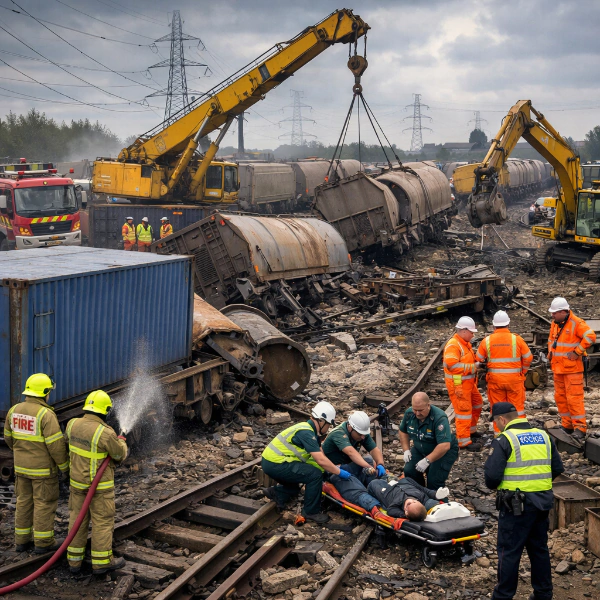
Rail freight plays a major role in Doncaster, yet the risks within depots, sidings, and industrial rail links often go unnoticed. These environments involve heavy machinery, restricted visibility, and tightly coordinated operations, making injuries both serious and difficult to assess.
Why freight injuries are overlooked
Freight operations happen in restricted, privately managed industrial zones, creating a visibility gap. The lack of public awareness does not reduce risk — it simply hides how these environments function.
Where incidents actually occur
Accidents usually happen in operational areas such as:
- loading and unloading zones
- sidings where trains are assembled
- internal crossings within industrial sites
These areas combine people, machinery, and moving stock in confined spaces, where coordination failures can quickly become dangerous.
How incidents typically develop
Rail‑freight accidents follow a chain of events:
- Normal operation — routine loading or repositioning.
- Risk introduced — communication issues, obstructions, or delayed signals.
- Escalation — reduced visibility or unclear coordination.
- Incident — collision, crush injury, or fall.
- Aftermath — multiple parties become involved in assessing what went wrong.
Responsibility rarely turns on the final moment — it depends on the entire sequence.
Why liability is complex
Freight environments often involve:
- rail operators controlling train movement
- site owners managing the facility
- contractors handling loading, maintenance, or support work
Control shifts throughout operations, meaning responsibility may be shared or divided across several parties.
Why these cases are harder to assess
Freight incidents require technical understanding. Challenges include:
- restricted access to sites
- reliance on internal reporting
- interpreting communication protocols and operating procedures
Two similar incidents can produce different outcomes depending on how the system functioned at the time.
Hidden risk factors
Common contributors include:
- limited visibility around moving stock
- reliance on radio/manual communication
- shared spaces between workers and machinery
- time pressure during loading
- inconsistent safety procedures
- multiple contractors without unified oversight
- unclear responsibility during joint operations
- restricted movement routes
- noise masking warnings
- delayed action on known hazards
These factors shape how risk develops and how responsibility is later assessed.
What determines whether a claim is possible
A claim depends on:
- duty of care
- breach of that duty
- causation
In freight cases, each element can be disputed. Breaches often relate to communication, supervision, or system control rather than a single mistake.
Evidence that matters
Key sources include:
- internal investigation reports
- operating procedures
- communication logs
- maintenance and inspection records
Access may be difficult, and interpretation often requires technical expertise.
Why assumptions about fault are unreliable
The person closest to the incident is not always responsible. Liability often sits with the party that controlled the conditions leading up to the event, not the individual involved at the final moment.
Where specialist legal support fits
Because these environments are complex, legal assessment requires a structured review of the full incident chain. Firms such as Marley Solicitors can analyse operational control, evidence, and the roles of all involved parties.
Final point
Rail freight risks are real, even if they are not visible. These environments rely on coordination and procedure; when one part fails, consequences can be severe. Understanding where that failure occurred is what determines whether an incident becomes a legal matter.