

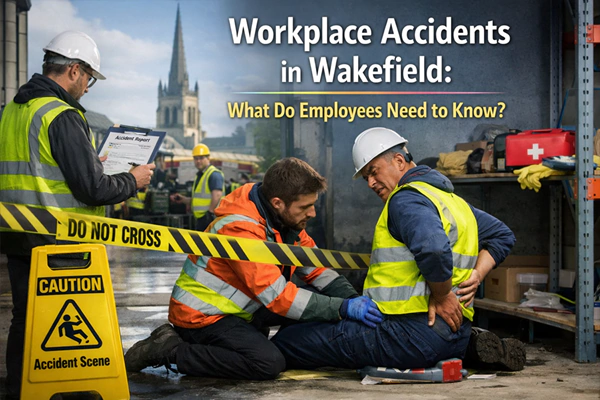
Workplace accidents in Wakefield can happen across a wide range of environments, from industrial sites and warehouses to offices and retail settings. While each workplace is different, the underlying expectation is the same: employees should be able to carry out their duties without being exposed to unnecessary risk.
When an accident does occur, it often creates uncertainty. Many workers are unsure if they should report the incident or take it further. Understanding how these situations typically unfold can make it easier to approach them with clarity.
In practice, workplace accident claims are not just about the incident itself. They are shaped by what happens immediately afterwards, how the situation is documented, and whether the employer followed the correct procedures, including timely reporting and investigation of the incident.
How a workplace accident typically unfolds
A workplace accident rarely exists in isolation. It tends to follow a sequence of events, beginning with the incident itself and continuing through reporting, an investigation, and, in some cases, a claim.
Immediately after an accident, the priority is safety. This may involve stopping work, securing the area and ensuring that the injured person receives adequate attention. In more serious cases, emergency services may be involved.
Once the immediate situation is under control, the focus shifts to recording what happened. Most workplaces in Wakefield are required to keep an accident book or reporting system. This creates an official record, which includes the time, location, and nature of the incident.
The next stage often involves an internal review. Employers may look at how the accident occurred, whether procedures were followed, and if any changes are needed to prevent similar incidents in the future.
If the injury is significant, medical treatment becomes part of the timeline. This supports recovery and provides documentation linking the injury to the workplace event.
From there, the situation may lead to a legal assessment. This is where the details of the incident are examined more closely to determine whether a claim may be appropriate.
What happens in the hours and days after the incident?
The period immediately following an accident can have a direct impact on how the situation is understood later, as initial reports and witness statements can shape the narrative and influence the outcome of any claims made. Key details are still fresh, and evidence is more readily available.
Employees are usually expected to report the incident as soon as possible. This ensures that it is formally recorded and that any hazards are addressed quickly. Delays can make it more difficult to establish exactly what happened, which can hinder the investigation process and potentially allow unsafe conditions to persist.
Employers may begin gathering their own information during this stage. This may include speaking to witnesses, reviewing any available footage and checking maintenance or safety records.
At the same time, medical attention should not be overlooked. Even injuries that seem minor can develop, and having a professional assessment creates a clear record from the outset.
How evidence builds over time
As the situation progresses, the strength of any potential claim depends on how well the events are supported by evidence.
Evidence does not usually come from a single source. It builds gradually, combining different types of information to create a consistent account.
- Records of the accident as reported at the time
- Medical documentation confirming the injury
- Witness accounts from colleagues present
- Photographs or footage showing the conditions
- Workplace records such as training logs or safety checks
Each element helps clarify not just what happened, but why it happened.
In Wakefield workplaces, this may include examining whether equipment was properly maintained, whether staff received adequate training, or whether workloads created unsafe conditions.
When a workplace accident may lead to a claim
Not every workplace accident results in a claim. The key issue is whether the employer met their responsibilities.
Employers are expected to take reasonable steps to reduce risk. This includes providing safe equipment, carrying out risk assessments and ensuring that employees are properly trained.
If an accident occurs despite these measures being in place and followed correctly, a claim may not be appropriate. But if there is proof that these duties were not fulfilled, the situation changes.
For example, if an employee is injured using faulty equipment that has not been maintained or is asked to carry out a task without proper training, this may indicate that reasonable steps were not taken.
A Wakefield workplace scenario in practice
An employee working in a distribution environment in Wakefield is asked to move heavy items without the appropriate lifting equipment. No manual handling training has been provided.
During the task, the employee suffers a back injury. The incident is reported, and colleagues confirm that similar tasks have been carried out without proper support. A review of workplace records indicates that training had not been completed.
In this scenario, the timeline of events helps clarify what happened. It shows not just the moment of injury but also the conditions leading up to it and the response afterwards. This process is what allows the situation to be assessed properly.
Why timing and documentation matter
Timing significantly influences the quality of evidence in workplace accident cases. The sooner an incident is recorded and documented, the clearer the overall picture tends to be.
Workplaces are dynamic environments. Equipment may be repaired, processes may change and staff may move roles. Acting early helps ensure that the relevant details are captured before they are altered or lost.
Documentation provides structure to what might otherwise be a series of unclear events. It allows each stage of the timeline to be understood in context.
Moving forward with a clear understanding
Workplace accidents in Wakefield can be complex, but they become more manageable when viewed as a sequence of events rather than a single moment.
By understanding how these situations typically develop, employees are better placed to respond effectively. Building a clear and accurate account involves reporting the incident, ensuring its documentation, and seeking appropriate support.
If the circumstances show that reasonable steps were not taken to maintain safety and an injury has occurred as a result, there may be grounds to take the matter further. Approaching the situation with a structured understanding helps ensure that nothing important is overlooked.