

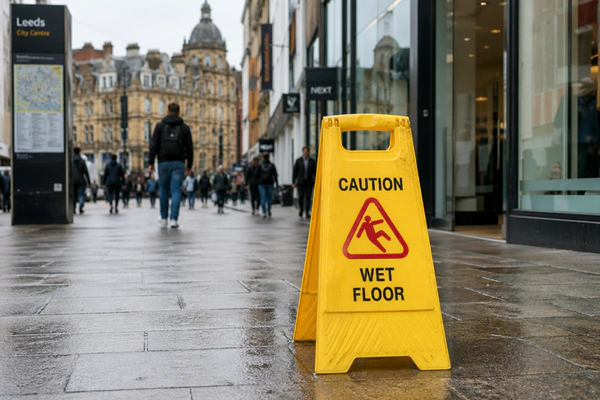
Leeds City Centre is one of the busiest urban areas in Yorkshire. With constant movement through shopping districts, transportation hubs, and public walkways, accidents can and do happen on a daily basis. High-footfall locations like this often lead to slips on wet floors, trips on uneven paving, or incidents in crowded retail environments.
In the moment, your focus will naturally be on the injury itself. However, what you do immediately after the incident can directly affect whether you are able to make a successful claim. Evidence is not just a supporting element. It is the foundation of any personal injury case.
Unlike quieter environments, Leeds City Centre often works in your favour when it comes to evidence. CCTV coverage is widespread, there are usually multiple witnesses nearby, and most businesses follow formal reporting procedures. The key issue is not whether evidence exists, but whether it is secured and used effectively.
Why evidence matters in city centre accident claims
To bring a successful claim, it must be shown that:
- A duty of care existed
- That duty was breached
- The breach caused your injury
Each of these points must be supported with clear and reliable evidence. Without it, even a genuine accident can become difficult to prove.
In a busy city centre setting, responsibilities are often disputed. A business, property manager, or local authority might refute the existence of a hazard or contend that they took reasonable measures to prevent it. We can challenge these claims based on evidence.
A typical Leeds city centre accident scenario
Imagine walking through a busy shopping arcade in Leeds City Centre. The floor has recently been cleaned, but no warning signs are visible. You slip, fall, and injure your wrist.
At first glance, the situation seems straightforward. However, without evidence, it becomes difficult to prove that the floor was unsafe or that the business failed in its duty.
Now consider the same situation with supporting evidence. CCTV shows the area being cleaned without signage. A nearby customer witnessed the fall. A photo taken at the time confirms the absence of warning signs. The incident is logged with management.
The accident itself has not changed. What has changed is the ability to prove what happened.
The most important types of evidence
Rather than relying on a single source, Leeds City Centre builds the strongest cases using a combination of evidence types.
- CCTV footage showing how the accident occurred
- Photographs of the hazard at the time of the incident
- Contact details and statements from witnesses
- An official accident report from the premises
- Medical records confirming the injury
Each piece plays a different role. Together, they create a consistent and credible account of events.
CCTV is particularly valuable in city centre environments. Many locations are monitored, but footage is often only stored for a short period. If it is not requested quickly, it may be lost.
Photographs help capture conditions that may change shortly after the incident. A spill may be cleaned, or an obstruction removed. Without visual proof, it becomes harder to demonstrate the hazard.
Witnesses provide independent confirmation. In busy areas, it is rare for an incident to go unnoticed. Their accounts can support your version of events and add weight to your claim.
Accident reports create an official record. This can prevent disputes about when and where the incident took place.
Medical evidence then links the injury directly to the accident, which is essential when pursuing compensation.
How responsibility is established in Leeds
One of the more complex aspects of city centre claims is identifying who is responsible. In Leeds, liability may fall on different parties depending on where the accident occurred.
For example, a fall inside a shop is typically the responsibility of the business operating there. An issue on a public pavement may fall under the responsibility of the local authority. In shared or managed spaces, such as shopping centers, responsibility may rest with a management company.
Evidence helps establish not only what happened, but who was responsible for maintaining the area and whether they met the required standard of care.
In some cases, additional documentation such as cleaning schedules or maintenance records may be used to show whether reasonable steps were taken to prevent the hazard.
Why acting quickly makes a difference
Timing is critical in city centre accident claims; conditions change quickly in busy environments.
Hazards are removed, areas are cleaned, and witnesses move on. CCTV footage may be overwritten within days. Delays can result in key evidence being lost.
Taking early action helps preserve the information needed to support your claim. This includes reporting the incident, gathering contact details and securing any available footage.
Prompt medical attention is also important. Assessing an injury, even if it seems minor, establishes a record for future reference.
Building a strong claim from the start
A strong claim is not based on assumptions. It is built on clear, consistent evidence that demonstrates what happened and why it should not have occurred.
In Leeds City Centre, the environment often provides multiple sources of evidence. The key is recognising their value and taking action before they are lost.
By focusing on evidence from the outset, you place yourself in a stronger position. Proper assessment of your case enhances your chances of a successful outcome.
If you have been injured in an accident in Leeds City Centre, understanding what evidence is needed is the first step towards moving forward with confidence.