

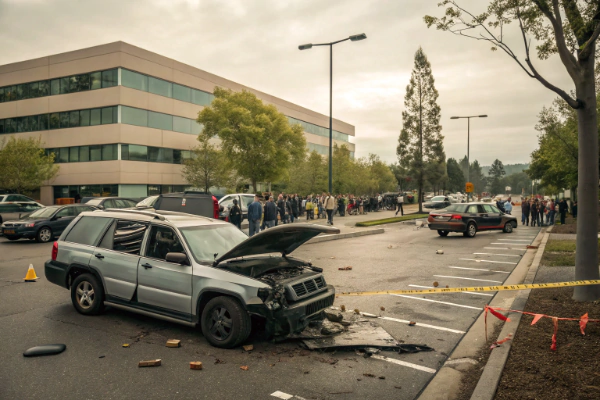
Not every road accident involving an employee is treated the same way. When a collision happens during work, the question is no longer just who was driving, but why they were driving, under whose control, and in what conditions.
Across Yorkshire, workplace vehicle accidents occur in delivery fleets, construction sites, agricultural settings, care services, and sales or service roles that require regular travel. What often causes confusion is the assumption that responsibility ends at the steering wheel. In reality, employer liability can extend far beyond the driver’s actions.
Understanding how these accidents are assessed helps explain when a workplace vehicle incident may justify a compensation claim.
When a road accident becomes a workplace issue
The defining factor in workplace vehicle accidents is work activity, not ownership of the vehicle.
An accident may be considered work-related where driving is part of the job, whether that involves deliveries, site visits, transporting equipment, or travelling between locations during working hours. This can apply to company vehicles as well as privately owned cars used for work purposes.
When driving becomes a part of one’s job, it raises questions about instruction, scheduling, training, and risk management. The focus shifts from individual errors to organisational controls.
Common scenarios in workplace vehicle accidents
Workplace vehicle accidents across Yorkshire occur in a range of settings.
They may involve delivery drivers operating under time pressure, employees travelling long distances between appointments, agricultural vehicles moving between sites, or staff using vehicles on construction or industrial premises.
Typical scenarios include:
- collisions caused by fatigue or long working hours
- accidents involving poorly maintained vehicles
- incidents on work sites with inadequate traffic management
- crashes following unrealistic schedules or delivery targets
- accidents involving employees unfamiliar with a vehicle or route
In many cases, the circumstances leading up to the accident are as important as the collision itself.
The role of employer control
The level of control over the work often determines the employer’s responsibility.
This includes control over schedules, routes, vehicle condition, workload, and expectations around speed or productivity. Where employees are required to meet tight deadlines, travel excessive distances, or drive without adequate rest, risk increases significantly.
Employers are expected to assess and manage these risks. Where driving is treated as incidental rather than integral to the job, safety planning is often inadequate.
Responsibility does not require direct instruction to drive dangerously. It can arise where systems or expectations make unsafe driving more likely.
Vehicle condition and maintenance
Vehicle safety plays a central role in workplace accident cases.
Employers are responsible for ensuring that vehicles used for work are roadworthy and suitable for the tasks required. This applies to company-owned vehicles and, in some cases, to privately owned vehicles used regularly for work.
Problems arise where maintenance is inconsistent, defects are reported but not addressed, or vehicles are not appropriate for the type of work being carried out. Tyres, brakes, lights, and load security are all common factors in workplace vehicle incidents.
Where mechanical issues contribute to an accident, responsibility may extend beyond the driver.
Training, familiarity, and supervision
Driving for work is not the same as personal driving.
Employees may be asked to operate unfamiliar vehicles, tow trailers, carry loads, or drive in challenging conditions. Without proper training or instruction, risk increases.
In some cases, employees are expected to drive long distances or in unfamiliar areas without adequate support. Supervision is often minimal, particularly where work involves lone driving.
Where employers fail to provide appropriate training or guidance, accidents may become foreseeable rather than unavoidable.
Evidence that matters in workplace vehicle claims
Vehicle accident claims in the workplace are often decided on evidence rather than assumptions.
Key evidence may include:
- work schedules and delivery logs
- vehicle maintenance and inspection records
- training documentation
- communications about deadlines or workloads
- accident reports and witness statements
- tachograph or telematics data where available
This evidence helps establish whether the accident arose from individual error alone or from broader system failures.
The impact on injured workers
Injuries from workplace vehicle accidents can be severe.
They may include fractures, head injuries, spinal trauma, and soft tissue damage, with recovery often complicated by the demands of work. Time off is common, and returning to driving roles may be delayed or impossible.
Beyond physical injury, workers may experience anxiety around driving, particularly where the accident occurred under pressure or in difficult conditions. This can affect confidence and employability.
Financial impact is also significant, especially where driving forms a core part of the role.
When a workplace vehicle accident may justify a claim
Not every accident involving an employee leads to employer liability. The key issue is whether reasonable steps were taken to manage driving-related risk.
A claim may be appropriate where an accident results from excessive workloads, unsafe schedules, inadequate training, poor vehicle maintenance, or lack of proper risk assessment. Responsibility may also arise where employers fail to review or adapt systems following earlier incidents or near misses.
Each case depends on the facts, particularly how driving was organised and controlled as part of the job.
Distinguishing personal driving from work driving
Whether the employee was “at work” when the accident occurred is a major issue in these cases.
Commuting to and from a fixed place of work is usually treated differently from driving between work locations or carrying out duties on the road. However, roles without a fixed workplace, or those involving regular travel, can blur this distinction.
Understanding how the journey fits into the working day is often critical in assessing liability.
Clarifying responsibility after a workplace vehicle accident
Workplace vehicle accidents usually involve more than just the immediate events.
They raise broader questions about planning, pressure, and responsibility. For workers across Yorkshire injured while driving as part of their job, examining the wider context of the accident can bring clarity to situations that initially appear straightforward.
Recognising when an accident reflects system failure rather than individual fault is often key to deciding what steps to take next.